
Romance & Intimacy
Falling in Love in Ubud
The Eat-Pray-Love fantasy, honestly. What it actually takes — and what it actually costs — to find something real here.
You came here, on some level, to be cracked open. Don't blame the place when it works.
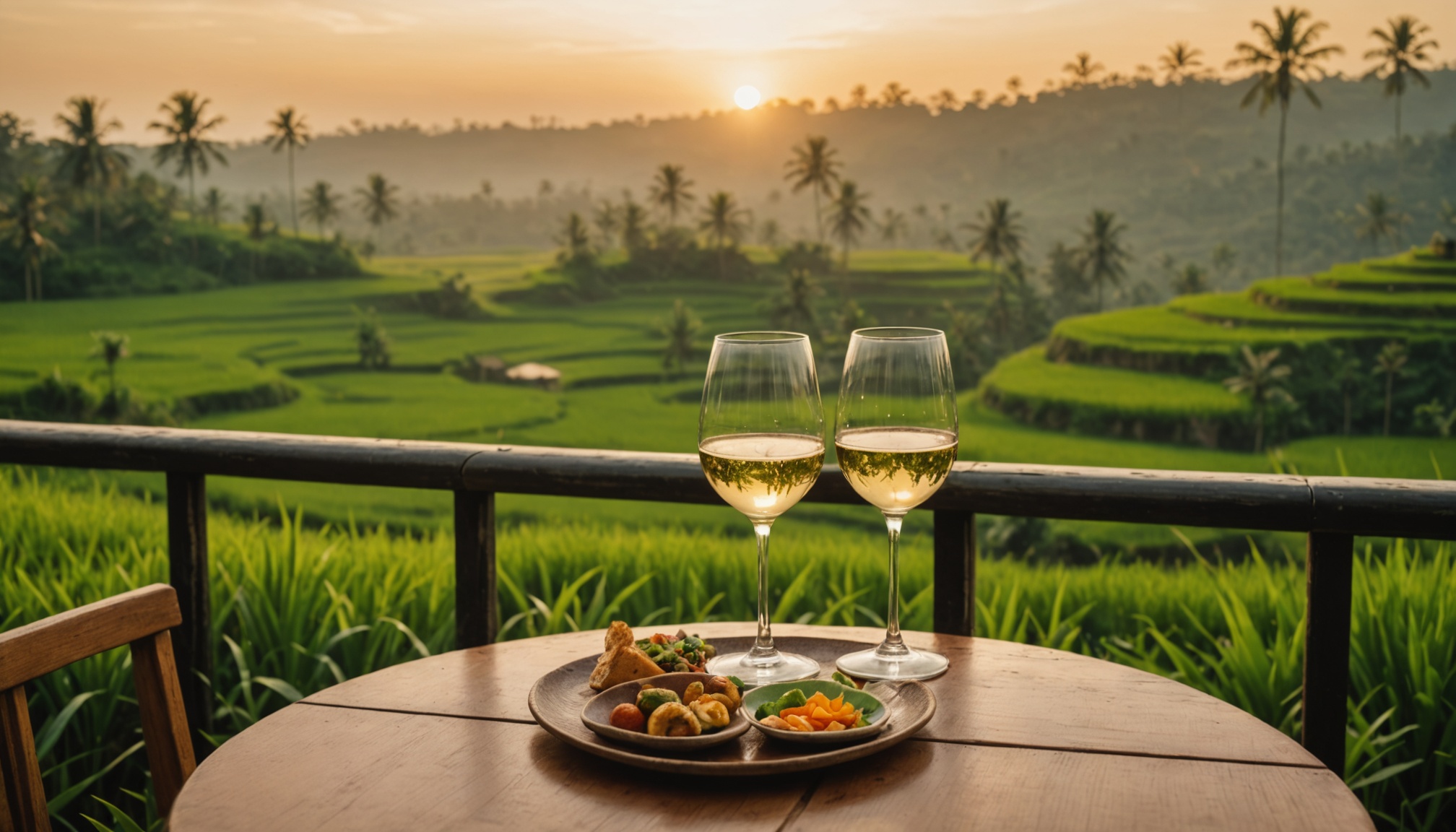
People come to Ubud to fall in love. They mostly will not say it out loud. They will say "I came for yoga," "I came for a reset," "I came because my marriage just ended" — and then, six weeks in, they meet someone at a five-rhythms class and start re-reading their own narrative.
Some of those connections are profound. Most are not. None of them happen by accident — Ubud is a small town with a small set of rooms, and the rooms are designed, whether their designers know it or not, to make people meet each other from the inside.
This is a guide to those rooms.
The premise
Ubud has an unusually high concentration of people who arrived here mid-rupture. Divorces. Career exits. Grief. Awakenings, real and performed. The expat scene skews toward people doing inner work, or attempting to, or hiding from it inside a community that says it does. The result is that the dating ecosystem here behaves nothing like the one you left.
People show up to the first date already in conversation about their childhood. The body work is normalised. Two-day relationships are taken seriously and grieved appropriately. Six-week relationships end in ceremonies. None of this is sustainable for everyone, but it is the water — and you should know what is in the water before you swim.
The rooms
There are roughly five categories of room where people in Ubud meet the person they will fall for. They are stacked in order of intentionality.
1. Ecstatic dance and 5Rhythms
Tuesday and Friday nights at Paradiso Ubud, Sunday mornings at the Yoga Barn — these are the high-contact rooms. People come to feel their bodies. People close their eyes and move and occasionally dance with each other for thirty seconds and learn more about a stranger than they would in a year of dinners.
The right way in is to come alone, dance for yourself, and notice what happens. The wrong way is to come scanning. People feel the difference instantly.
Event
5Rhythms with Sophie
Friday morning 5Rhythms with Sophie. Drop-in welcome.
View event2. Tantra and intimacy work
Workshops, weekly circles, ceremonies. The intentional, capital-T capital-W ones — Tantra Workshops — are not, contrary to outside assumption, thinly-veiled pickup environments. They are rigorous. The facilitators are usually serious. The participants are usually women who have done a great deal of therapy and men who are catching up.
If you are arriving expecting a sexual frontier, you will probably be disappointed and possibly removed. If you are arriving looking for the kind of intimacy that comes from being seen completely by another person doing their own work, you have a chance. The threshold is real, the demands are real, and the people who come out the other side often find each other.
3. Cacao circles, breathwork, ceremony
Slower, more facilitated, more contemplative. You will not meet anyone in a state of charged-up flirtation here. You will meet people in a state of opened-up tenderness, which is a different and slower path to romance, but a real one. The connections that begin in cacao tend to last longer than the ones that begin on the dance floor.
4. The food places that double as community
A short list, in no particular order: Yellow Flower Café (jungle and tea), Ubud Spice (long shared dinners), Tukad Cepung (a coffee at the river), Pomegranate (slow food, slow conversation). These are places designed for two people to talk for three hours without anyone hurrying them. Use them.
5. Retreats
The fully-curated path. Six to ten people, six to ten days, a structured invitation to do the work together. Romance is not the point of any retreat worth its price tag, but romance happens — because people in retreats are the most fully themselves they have been in months.
What it costs
Real connection in Ubud costs the same thing it costs anywhere: showing up, with your defenses down, repeatedly. The local discount is that the rooms are designed for that to happen faster. The local tax is that the same speed often produces relationships that don't survive the return to ordinary life — Ubud connections are dense and they decompress strangely when one or both parties leaves the bubble.
This is not a reason not to do it. It is a reason to do it with eyes open.
A few things people get wrong
- The scene is not a substitute for therapy. Ecstatic dance is not a treatment plan. If you came here to dance through unprocessed grief, you will dance through it for a while, and then you will need a therapist.
- The men outnumber the women in some rooms; the reverse is true in others. The dance scene is roughly even. Tantra workshops skew female. Cacao circles skew female. The bar at Yellow Flower skews male.
- Do not romance your facilitator. The reason this rule exists is that it is broken often.
- People who tell you about their connections within thirty seconds of meeting you are usually not the connection you want.
- Ubud is a small town. Word travels. This is, on balance, a good thing.
A path
If you have just arrived and you want to give this an honest shot, the cleanest first move is:
- Two weeks of going to one ecstatic-dance class a week and one cacao circle a week, alone, with no agenda.
- One workshop per month, the more uncomfortable-sounding the better.
Six weeks in, you will have a much clearer sense of whether what you are looking for is here, in you, or somewhere else entirely. All three are useful answers.
The Ubud you came to find is not the same Ubud you will leave with. The town keeps its part of the deal — but the deal was always with yourself.
When you want it hand-held
The free path above works for many people. For others, the open-ended structure is the problem — too many rooms, too little orientation, six weeks of decision fatigue. That is what retreats are for: a curated, embodied, honest container for the same work.
Mentioned in this guide
Where to go from here
Place
Paradiso Ubud
The community dance studio — ecstatic dance, contact improv, 5Rhythms, plant-based kitchen downstairs.
Place
Yellow Flower Café
Penestanan ridge café — long-running, plant-forward, the kind of place you write in.
Event
5Rhythms with Sophie
Friday morning 5Rhythms with Sophie. Drop-in welcome.